Evening and Night Paddle Equipment
Evening and night paddling can be a risky proposition or a pleasant journey. It all depends on your frame of mind, the risk you are willing to take, the weather, the tide, the location, the phase of the moon, the paddling partners with you, and the equipment you have on board. If this sounds confusing, it should be. Like daytime paddling, it involves risk assessment. But every time we go paddling we assess the risk vs the reward. The main difference is in the evening or at night we can not see as well, and others may not see us as well. But there are elements that come into play at night that help mitigate the risk. On summer days the wind usually dies down in the evening. There will be less boat traffic to keep track of and the moving boat lights make it easier to pick out traffic. Where the majority of the boat traffic is non-commercial, as in Narragansett Bay, Rhode Island, traffic quiets down except for the occasional fishing boat chugging back in. With cool air settling out over the calm water, a sound channel is formed which allows sound to travel much farther than in the daytime. You will be able to pick up power boats some distance away that you would not hear in the daytime. The only boats that make no sound are sail boats, but the visibility of their high mast lights and slower speed reduce the risk of danger to you.
Any area that you are paddling at night should be well known to you and or your paddling partners. You should have planned where you are going so you will know what to expect as landmarks or marine markers. If available, try using a mapping GPS to help you identify your location at night. Be sure to purchase one of the proper nautical maps that show the coastal contours, which means one of the commercial Blue Chart maps for your GPS.
Night paddling is not the time to explore new frontiers. But most people enjoy moonlight paddling, which probably accounts for 90% of the night paddles. These are the type of paddles being referred to in this article, but anytime when venturing on the open water at night, or when by some chance you may not get back to the launch site before it gets dark, you should be prepared to paddle in the dark. You should also be aware of any changes in the weather that might make any return paddle more risky in wind, waves and tide.
Everyone should assess how risky any paddle will be, that includes daytime paddling as well as evening and night paddling. The ability to assess a paddle is only gained by practice and experience. You will only gain this experience by daytime paddling in many different conditions and by evening and night paddling. So read the following and consider whether you are equipped to paddle in late evening or at night.
The only requirement for kayaks in open waters at night to meet Coast Guard requirements are the wearing a Type III PFD, carrying a noise making device and carrying a flashlight that can be directed at any boat that might be on a dangerous course toward the kayak. Fairly minimal requirements that should be improved on. The following is a list of the equipment that you should seriously consider using on late evening or night paddles.
Always carry your normal compliment of daytime equipment ,which should include a good PFD, a towing line, extra paddle, VHF radio, a deck compass, first aid kit, water and snacks, maybe binoculars, deck or river knife, and a dry bag of extra clothing. The 'dry clothing' bag should include, a towel, fleece or wool pants and pullover, wind proof pullover, extra jersey, wool hat and thin wool gloves. Depending on the season, extra outer clothing may be included, such as an extra paddle jacket, rain hat, etc. Or in the heat of the summer with warm water, leave the wool clothing home. What you carry in your dry bag should be capable of fully clothing you, or someone else, in an emergency once out of the water, consistent with the water and air temperature. It is also wise to carry a 'safety 'dry bag which would include items needed rarely, but essential when needed. Examples are duct and electrical tape, a multipurpose tool (e.g. leatherman knife), various pieces of cord, an LED flashlight with alkaline batteries, extra batteries for all electronic equipment including your VHF radio, matches or butane lighter, extra paddle leash, extra glow sticks, extra sunglasses, extra eyeglasses if you use them, and last but not least, a short roll of toilet paper.
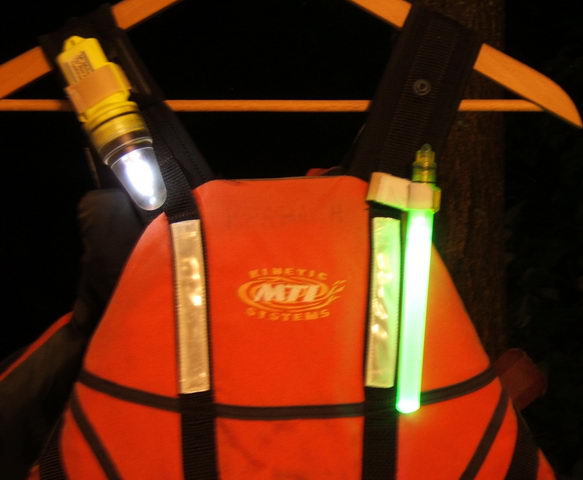
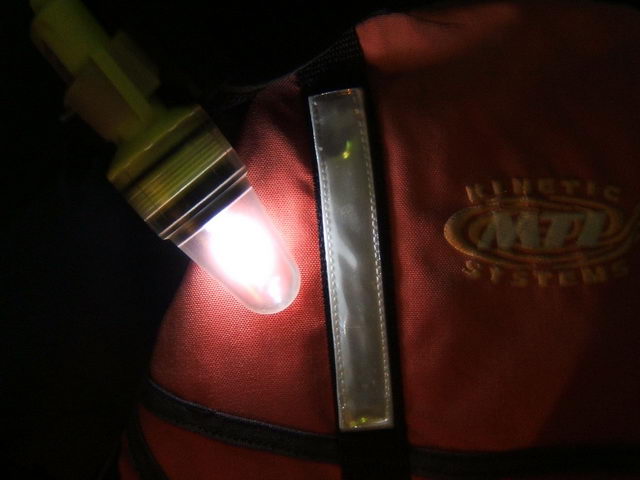
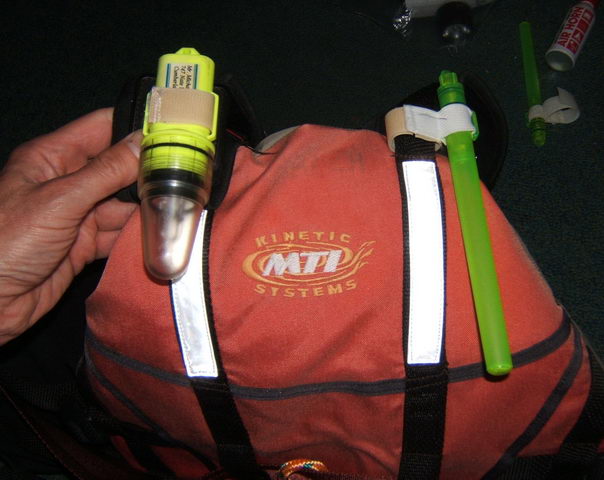
For late evening and night time paddling more gear needs to be carried. The first item is a xenon strobe light for emergency such as the Princeton Tec seen below. This light is waterproof and specifically designed for kayaking or scuba diving. It uses one AA battery, and since you want the longest shelf life and the longest flashing duration, a lithium battery is recommended. In the photos below the strobe is attached high and to the rear of the PFD. But where you can reach it to twist it on.
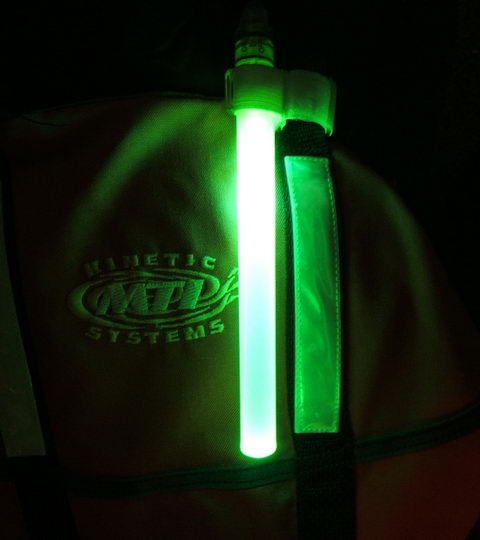
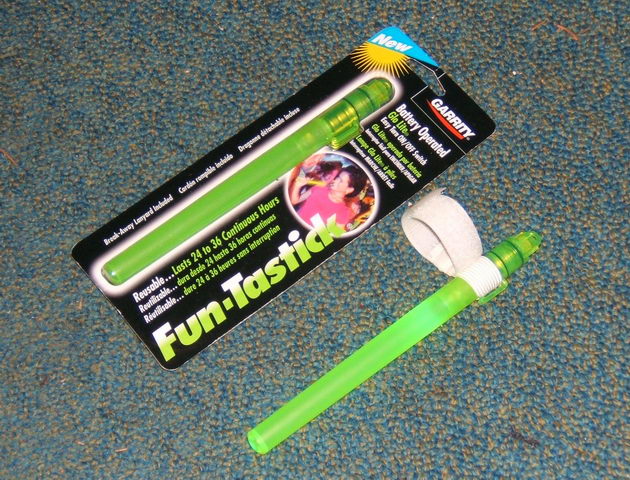
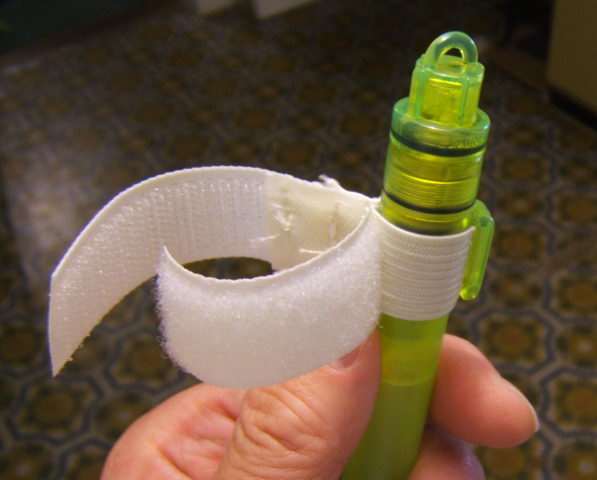
The other light on the PFD is a green glow stick. Better than a chemical glow stick is a battery model called the Fun-Tastick Glo Lite obtained at Walmart for $2.48 each. They last about 24 hours and have an on-off switch to conserve battery power. They are about twice as bright as the common chemical glow sticks and last much longer. See a comparison. It is worn on the opposite shoulder in the back to keep the light out of your eyes and allows the paddler behind to follow follow you. The soft glow does not affect the night vision of the following paddler and the green color differentiates it nicely from the house lights along the shoreline in the Bay. Any vessel approaching from the rear also would not confuse it with a shoreline light, and on a dark night is easily noticeable at least to 500 feet away. There are many ways of attaching the glow stick to the PFD but one method is to attach the glow stick to the shoulder strap with a homemade Velcro (tm) strap and elastic loop. Some people attach the glow strip to the top of their hat.
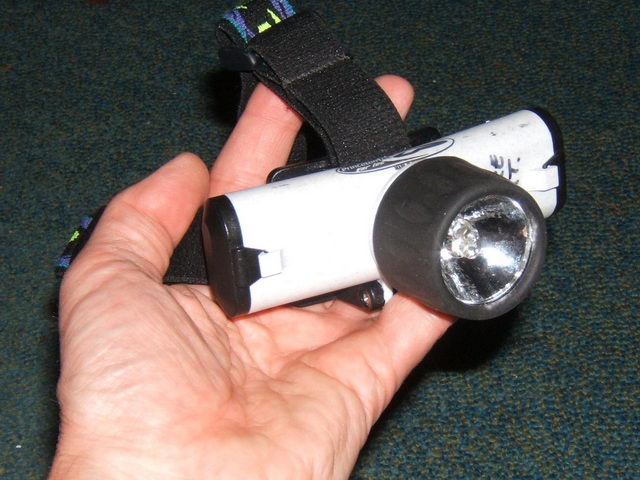
For general vision around the kayak, use a waterproof headlamp that has a fairly dim LED bulb that will last over 12 hours. The photo below shows a four cell LED model headlamp. Use alkaline batteries in this light (and the dry bag flashlight) because they have a good shelf life. While NiMH rechargeable batteries are cheaper they will loose charge over a month and when you need them they may not have a good charge. In dark conditions when the stars or moon are out, keep the light off to preserve your night vision. When paddling in Narragansett Bay there is usually light from sky glow, and the headlamp can be left off. On cloudy nights, but not foggy or rainy nights, the sky glow off the bottom of the clouds makes it even easier to see on the Bay.
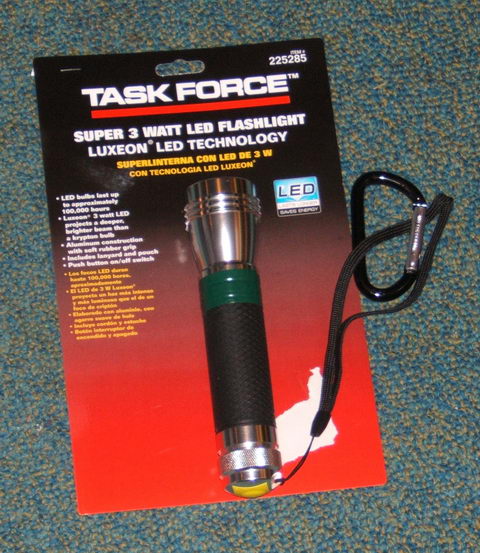
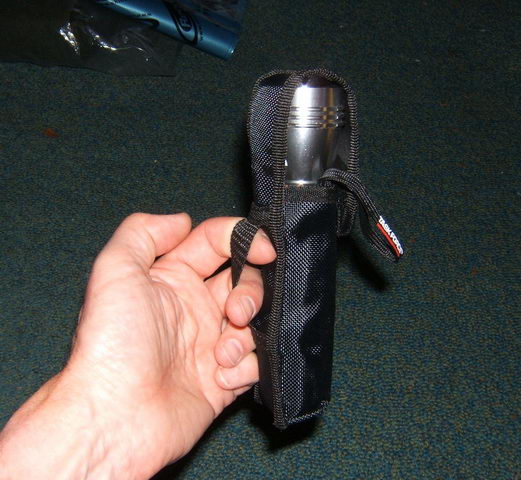
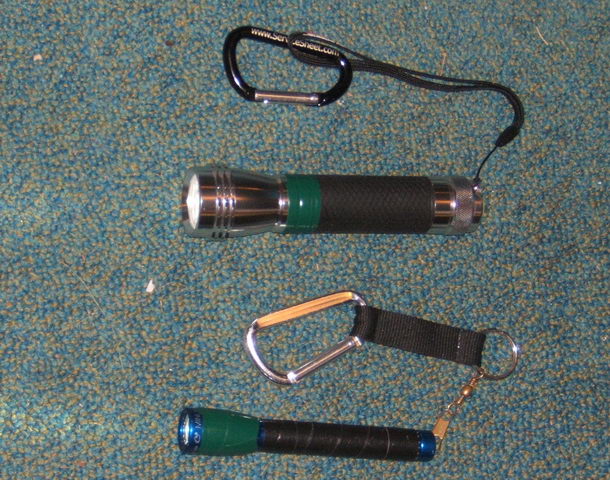
For a backup light you should carry a stronger LED light, attached to you or the kayak. In the photos below a mini carabiner is used to clip the light to the front of a PFD. The photos below show two solutions. I personally carry a 2.4 watt LED bulb in a mini-mag light housing. It has a regulated output for 1 hour and is very bright. Since this light is a custom $60 item, most paddlers will not have access to one. An acceptable alternative is a 3 watt LED sold by Lowe's home center. The light uses two “C” cells and has 2.5 hours of regulated light, after that it drops down to fairly dim. This light is sold under the brand 'Task Force' and is $40 and available at all Lowe's stores. It has a very bright and narrow beam and appears waterproof. To make sure put a piece of electrical tape on the end push button switch. This is the only place on the light that is not O-ring protected. It can be hung with a carabiner to the PFD or attached to the kayak with the nice pouch with belt loop that comes with the light. You will still want to secure the light with a lanyard to the boat in this case.
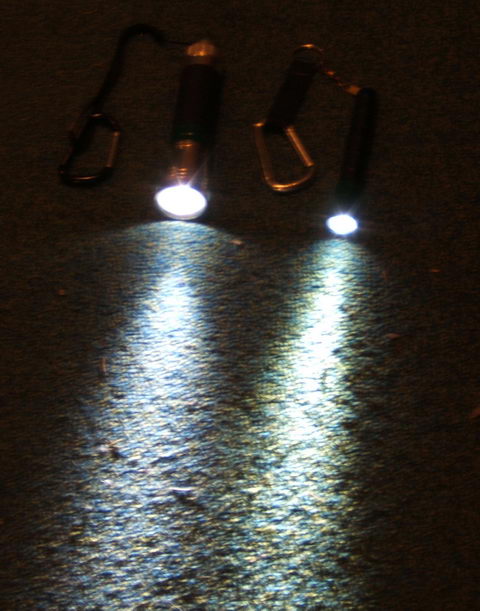
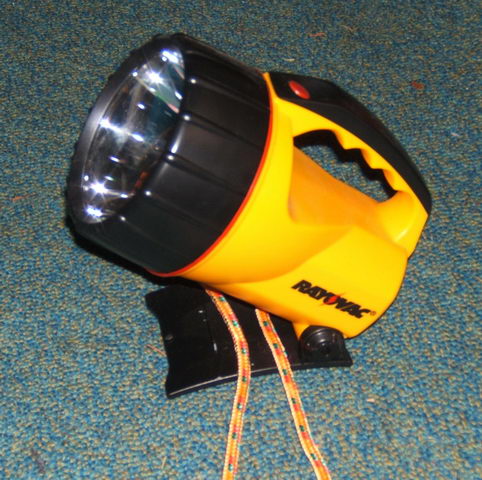
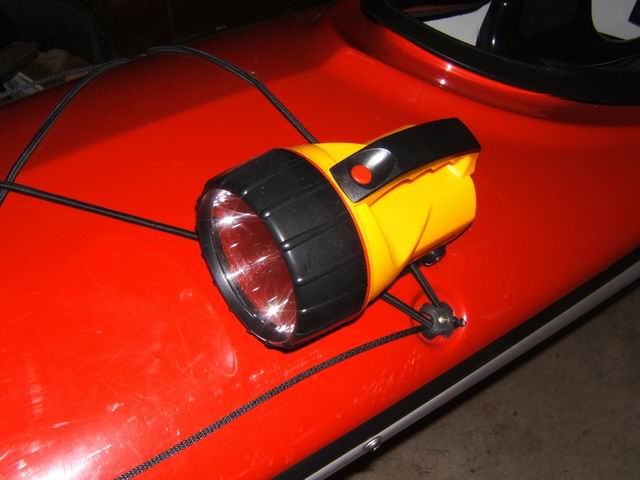
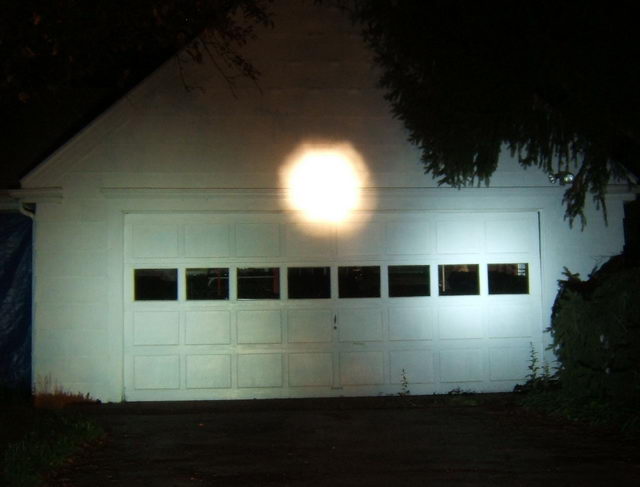
Much cheaper is the main lantern which is a Ray-O-Vac floating waterproof 6 volt light in the photos below. Priced at about $7 at your local WalMart, it is cheap enough for everyone to have one. It has a very narrow strong beam that only spreads about 15 feet in 300 feet. With this light you will appear much bigger than a kayak to a larger vessel approaching you. The added advantage is the folding stand on the bottom which is perfect for attaching under the deck cords or bungees in front of you in the kayak. This makes it secure and allows you to direct it straight ahead when paddling. When flashing an oncoming boat ,do not wave it back and forth. It may look to the other boat that you are signaling a distress. Just point the light several times straight at the boat and hold it for a couple of seconds. Watch for a reaction from the boat, it will either flash a light in your direction, change course, or slow down. If nothing happens, repeat the procedure until you get a reaction or know definitely they will pass you at a safe distance. The photo below shows the difference in the beam patterns and intensity from a distance of 50 feet. From left to right; the 2.4 watt AA LED minimag, the Ray-O-Vac 6 volt lantern, and the 3 watt Lowes LED flashlight.
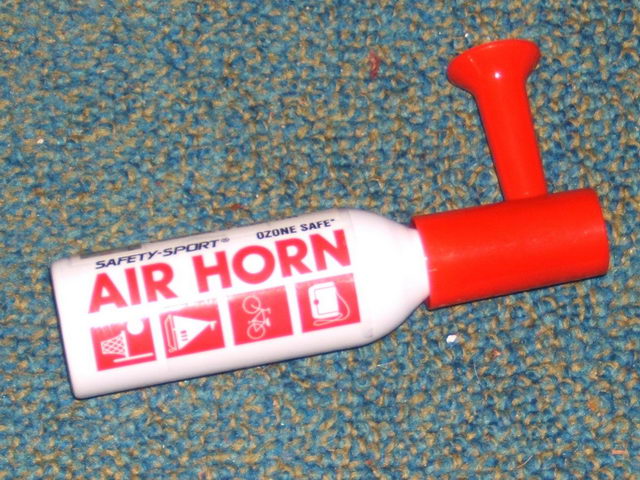
For a noise maker, carry an air horn. This smaller model below is about $6 and is easy enough to carry for that emergency when you want to be heard. It is also carried if there is any chance of daytime fog.
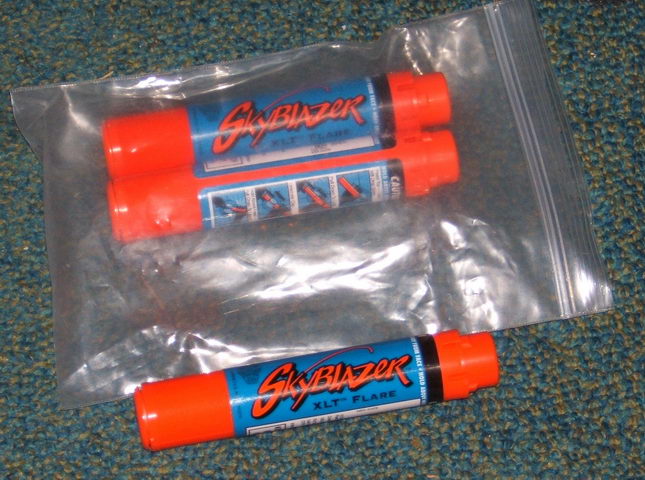
For more desperate moments which hopefully never come, carry a packet of hand launched aerial red flares. These cost about $15-$20 and would be handy if stranded or floating some where in the dark. I have heard that the failure of these devices is as much as 50% because of moisture getting past the o-ring seals, so I keep mine sealed in extra heavy, 6 mil, 5x7 inch resealable vinyl bags.
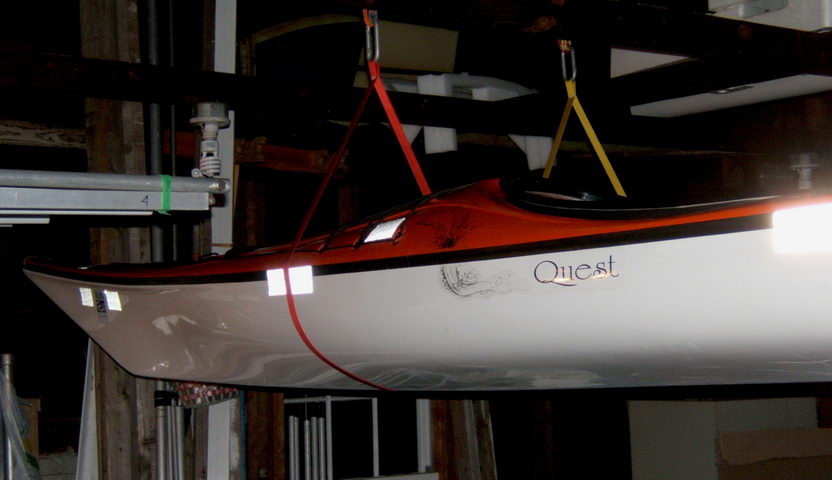
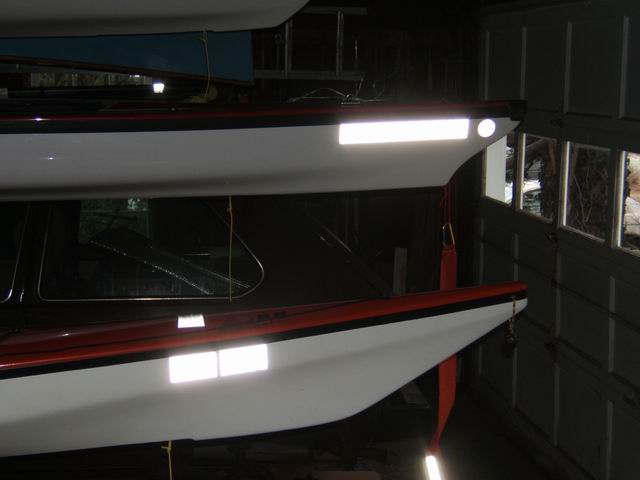
Last but not least, use SOLAS approved high reflectance tape on the sides of your kayak as seen in the photographs. One source of the tape is http://www.identi-tape.com/solas.html. The 2 “ wide tape comes in 10 ft rolls which is enough tape for two kayaks. A better pattern than seen in the photos can be done with 5 ft of tape, if 13”strips are put on each side of the bow and stern, and 4” pieces on the top of the bow and stern. That scheme would get more tape higher, and the larger strips would be visible at greater distances. This tape which is about $2 per foot, is a rubbery tape that is specifically designed by 3M to be used in the marine environment. It is flexible and fits contours easily. It will stick to almost anything, including paddle jackets and PFD's. It is very difficult to remove. For extra visibility, apply tape to paddle blades, front and back, and to anything else that might float off in the night, such as your bilge pump.
rev. 6-11-2006